3.7% Conversion in Chat: How micasa Turns Every Customer Question into a Better Shop
29 September 2026

From Corporate Group to Entrepreneurial Mode
micasa is a Swiss home furnishings retailer with 45 years of history, 30 stores and around 15,000 furniture and home accessory products. Just over a year ago, the company spun out of a large corporate group through a management buyout and completely repositioned itself within just six months – from its systems landscape to its online shop. Three people work in e-commerce.
Selling furniture means providing advice. Customers ask about dimensions, materials, care and how products can be combined – but hardly anyone sends an email for that. Questions arise when the time is right: at 11:14 p.m., when all 30 stores are closed and no one in customer service is available anymore.
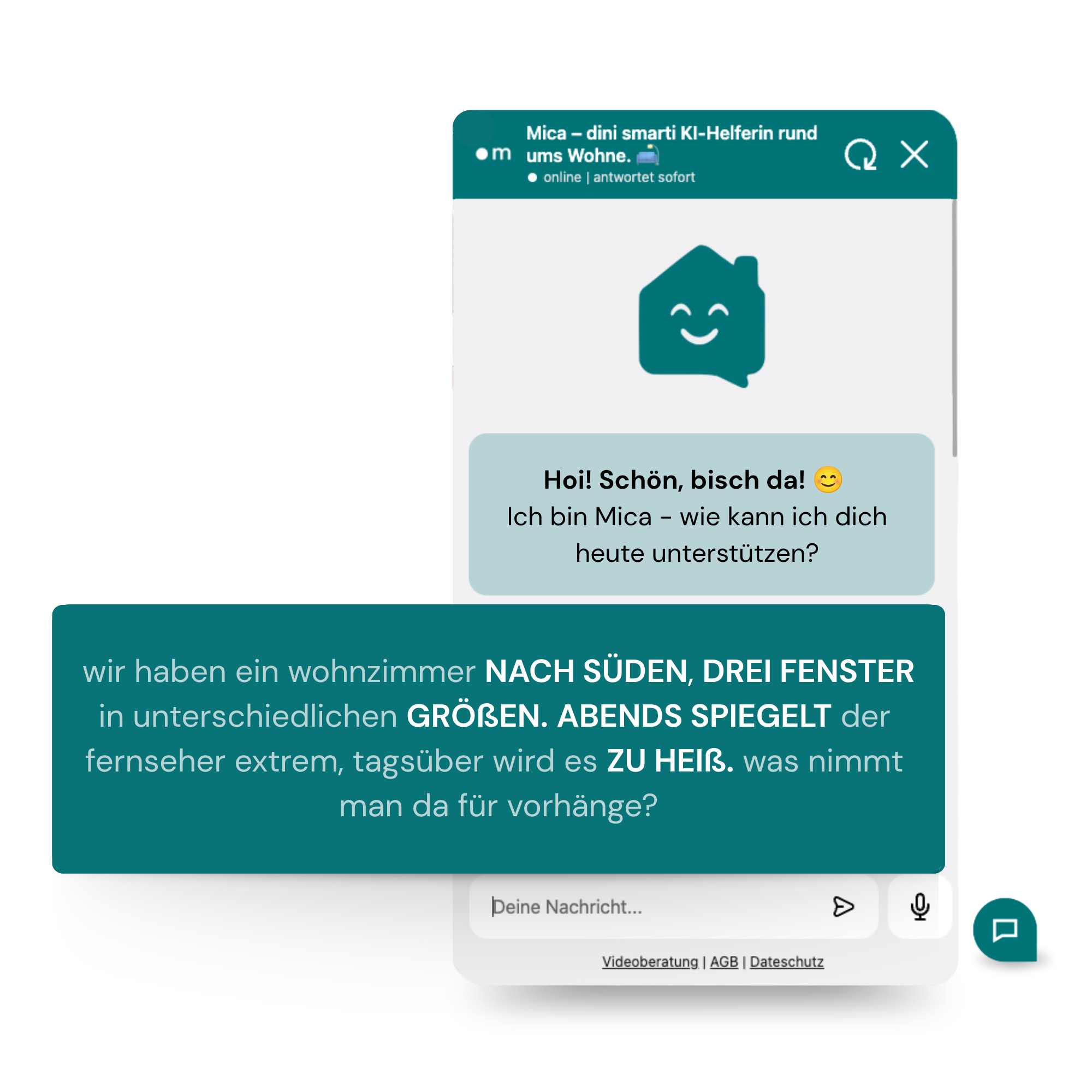
That is exactly when a question like this comes up: “We have a south-facing living room with three windows of different sizes. In the evening, the TV reflects terribly, while during the day it gets too hot. What kind of curtains should we use?” No filter in the world can answer that – and no statistic would ever have captured that this question existed in the first place.
The Solution: homie AI – Connected, Live and Learning
From onboarding to go-live: two weeks.
Shopify as the shop system, connect the product data feed, install the app – within just a few minutes, the assistant was ready to respond. No development team, no months-long implementation, no business case requiring a hundred approvals. Just two weeks passed between onboarding on July 1 and going live on July 15.
micasa deliberately started with product data that was not yet perfectly clean everywhere, following the principle: build to learn instead of waiting until everything is perfect. Before going live, all 550 employees tested the assistant for two weeks – without a single negative result.
The longest part was not the technology, but the language. The shop runs in German, French and Italian; the assistant also understands Swiss German and responds in Standard German using Swiss vocabulary. The team defined in advance how it should respond to comparison questions, provocations or topics outside the product range: in words, not in code.
How homie Supports micasa Today
Advice Across the Entire Product Range, Around the Clock
The AI assistant accesses the complete product data feed and answers questions that no filter can capture: south-facing rooms, glare, three different window dimensions. Customers describe their situation, and the assistant thinks along with them. Even when no store is open anymore.
Since going live, around 10,000 advice conversations have taken place in two months: advice that simply did not happen before because no one picked up the phone or wrote an email for a quick question. On average, four messages are enough to resolve an issue – nobody gets lost in the chat.
Questions Directly on the Product Detail Page
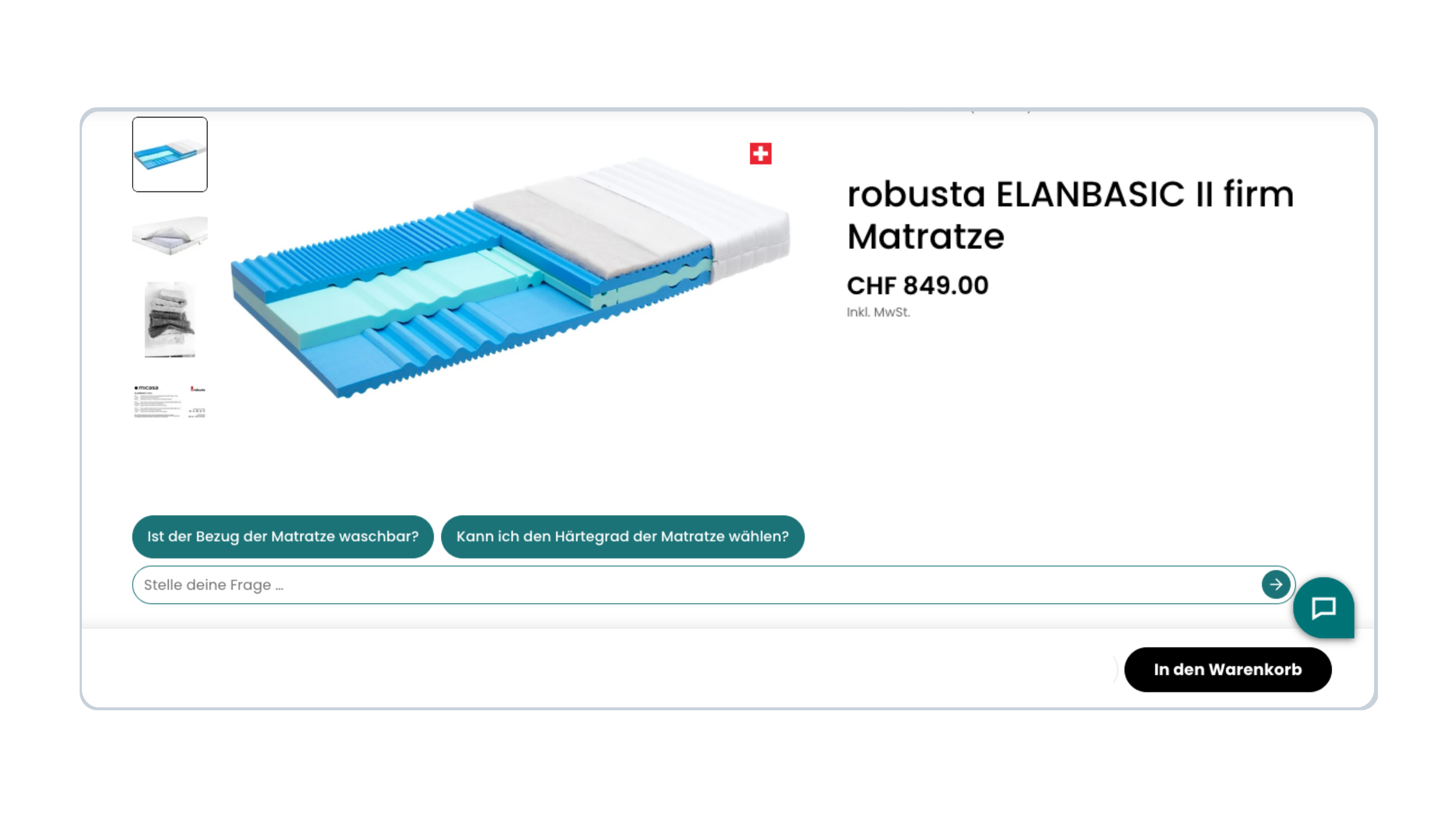
Since September 2026, the assistant has suggested relevant questions on product pages: “Is the mattress cover washable?” and “Can I choose the firmness level?” The questions are AI-generated and can be adjusted at any time. They anticipate common questions and reduce uncertainty before purchase – especially for high-priced products that require more explanation.
The number of advice conversations has increased by 133 percent since then. And because each question remains linked to the respective product, the team can see exactly which products require clarification.
Conversations as a Data Source for the Shop
Chat Analytics automatically evaluates every conversation: title, summary, tags, the most common question types and sentiment – whether a conversation was positive, neutral or negative. This makes visible what would otherwise go unreported.
For example, the internal term “delivery to the place of use” repeatedly caused questions in conversations. Today, it is called “delivery to your desired location”. The same analysis shows where the product data does not provide an answer: dimensions, materials, care and how products can be combined.
What would otherwise be an endless data task becomes a prioritised list. The effort involved is around two hours per week.
The Results: Numbers That Speak for Themselves
The clearest number is conversion. Among users who interact with the chat, it is 3.7 percent, compared with just over one percent across the shop as a whole. One pattern micasa has observed since the start: customers who ask questions are significantly more likely to buy.
There are also around 10,000 conversations in two months, an average of four messages per conversation and a 133 percent increase in advice conversations since questions were added directly to product pages. The assistant covers the entire range of around 15,000 products in three national languages and went live two weeks after onboarding.
However, the change that has the greatest impact on day-to-day work does not appear in any of these statistics. micasa has not just gained another channel, but an ongoing source of feedback showing where its own shop is not easy to understand. Every revised piece of copy and every added product detail can be tested in subsequent conversations. As a result, the shop gets a little better every week – and so does the assistant, because it accesses exactly this data.
What the Customer Says
“We started small instead of planning for months. After two weeks, the assistant was live – and it has been delivering ever since.”
Christina Alessio, Head of Marketing & Digital Commerce, micasa
Advice That Scales – and Makes the Shop Better
An AI assistant does more than improve service on a website. It makes the shop itself better because it shows where language, data and advice fall short – and it makes the target audience easier to understand by revealing what customers are really looking for, what makes them hesitate and what they would never write about on their own.
At micasa, this takes three people on the team, two weeks to go live and around two hours per week. The rest is handled by the conversations with homie AI.